 |
|
'not mad as
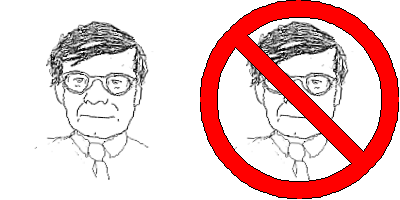
a hatter' |
 There are many eye-brow raising sentences in Ted Honderich’s paper
“Consciousness as Existence, Devout Physicalism, Spiritualism”, accessible
on his own web-site.
Not the least surprising is the confession, half-way through,
that the paper was rejected by the Journal of Consciousness Studies. The
lack of reserve here will be familiar to readers of Honderich’s remarkably
frank autobiography “Philosopher: a kind of life”. There are many eye-brow raising sentences in Ted Honderich’s paper
“Consciousness as Existence, Devout Physicalism, Spiritualism”, accessible
on his own web-site.
Not the least surprising is the confession, half-way through,
that the paper was rejected by the Journal of Consciousness Studies. The
lack of reserve here will be familiar to readers of Honderich’s remarkably
frank autobiography “Philosopher: a kind of life”.
But what’s going on? Honderich, now retired, had a
long and eminent career in philosophy. He is the former Grote Professor at
University College, London; author of many magisterial works, notably
on punishment, free will, and the justifications for terrorism. He
has himself acted as editor for more philosophy books than you could
conveniently shake a stick at. You really wouldn’t expect him to be
getting many flat rejections at this stage. |
|

|
|
 I think I can shed some light on that.
I believe the JCS must have rejected the paper because it just makes no
sense. I’ve read it carefully, and it’s not that I disagree with Honderich
– I just cannot make out what he is getting at. Look, he says ‘For you
to be conscious of the room is, it seems, for the room somehow to
exist.’ I’d like this sentence a lot better without the ‘it seems’ and
the ‘somehow’, but those are minor quibbles. Can he really mean that the room’s
existence is the same thing as my being conscious of it? If so, it follows
that I must be conscious of everything that exists. Which is surely
nonsense. Equally, if my being conscious of the room is merely a fact
about the room (that it exists), the state of my brain at the time is
irrelevant. So I could have exactly the same brain state while conscious
of the room as I have while I'm not conscious of it. Which is also surely
nonsense. I think I can shed some light on that.
I believe the JCS must have rejected the paper because it just makes no
sense. I’ve read it carefully, and it’s not that I disagree with Honderich
– I just cannot make out what he is getting at. Look, he says ‘For you
to be conscious of the room is, it seems, for the room somehow to
exist.’ I’d like this sentence a lot better without the ‘it seems’ and
the ‘somehow’, but those are minor quibbles. Can he really mean that the room’s
existence is the same thing as my being conscious of it? If so, it follows
that I must be conscious of everything that exists. Which is surely
nonsense. Equally, if my being conscious of the room is merely a fact
about the room (that it exists), the state of my brain at the time is
irrelevant. So I could have exactly the same brain state while conscious
of the room as I have while I'm not conscious of it. Which is also surely
nonsense.
|
|
|
|
So what can he mean? He says that what is normally, or by some
people, taken to be the contents of consciousness are in fact, more or
less, consciousness itself. What could that mean? I can imagine someone
declaring that the contents of a book were the book (rather than
any actual physical copy of the book), but how would that apply to
consciousness? It seems that if you interpret it one way it becomes
vacuous (the fact that consciousness has contents is what distinguishes it
from unconsciousness); if you interpret it another it becomes absurd
(there is no distinction between the conscious thing and the thing it is
conscious of). |
|
|
|
Honderich doesn’t give us all that much
help in the course of the paper. He compares his theory with hard-line
materialism and with dualism (the ‘devout physicalism’ and ‘spiritualism’
of the title), and he rates it against four criteria which he seems to
take as obvious, but which in fact seem rather arbitrarily chosen. None of
this helps much in the basic task of grasping his meaning. At one early
stage I wondered if we were heading towards some kind of idealism, but
Honderich, pointing out that he is ‘not mad as a hatter’ says his
views are nothing to do with Bishop Berkeley, and no kind of
epiphenomenalism, either. |
|
|
| I
think you have to remember that Honderich has been struggling with the
mind-body problem since long before it became so fashionable. I think part
of his reason for stressing existence is simply to short-circuit the
argument from error which was still strong thirty years ago (actually it
still crops up). According to that argument, the fact that we are
sometimes wrong about our perceptions shows it’s really only sense-data,
or images we perceive – by stressing that true consciousness involves the
existence of the perceived, Honderich rules that line of thinking firmly
out of court. |
|
|
|
I don’t think the theory is quite as
confusing as you maintain, but I do have a bit of difficulty deciding
whether it is meant to be relativistic or absolute. Some of the things
said imply that each conscious entity exists in its own perceived world,
where indeed existence and consciousness coincide, but it’s also a key
point for Honderich that his argument makes consciousness a
straightforward physical phenomenon, amenable to physical investigation.
I’m not sure how these two claims can be reconciled.
We mustn't
forget, of course, the possibility that Honderich has got it absolutely
right, and cracked the ultimate mystery of consciousness - but that we're
still too stupid to understand the answer, even when it's explained to
us. |
|
|
|
Honderich himself doesn’t seem
to regard the theory as the final truth, though. He claims that it has the
desirable quality of explaining its own limitations – if consciousness is
like this, no wonder it seems permanently mysterious – and suggests we
might see merit in several different theories – pursue several in tandem.
That doesn’t seem to me an unappealing
perspective.
More... |