|
|
|
1 April 2004 |


|
|
|
|
Grand, as you probably know, became famous as the brains behind the computer game 'Creatures', which used a far more sophisticated version of 'artificial life' than any of its predecessors or competitors (or successors, I suspect). In some ways, however, Grand represents an older tradition of computer games design. There was an era when computers were readily available but processing power, storage, and graphics were still severely limited. In those days it was relatively normal for an individual with a good idea to run up a world-beating game alone in his bedroom or garage. When better graphics came along and computer games started emulating feature films, all that changed. But it is in the same sort of spirit that Grand has set out to build a better robot, believing that one good man with a sound idea can achieve more than a vast instituion governed by committees. He derides those who claim that the geometric increase in computer power predicted by 'Moore's Law' means that true machine consciousness is only a matter of time. What exactly is he trying to achieve? Not a human level of consciousness, though he appears to have set his sights on an orang-utan, surely among the most thoughtful and reflective of animals. He believes that building a physical robot, and one which works in the same way as a real animal (its voice generated by real mechanical mouth/throat action rather than a chip, for example) is the most enlightening way to carry out this exercise, and he has some interesting ideas about how neural" systems might be set up in such a way that they structure and organise themselves merely through experience. | |||||
|
| |||||
|
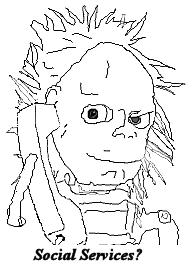
There seem to me to be a few contradictions (or tensions, at least) in what he says. He says it's no good building bits of an organism in the hope of later patching them together - you have to have the whole thing for it to work properly. Yet he's missing out the higher levels of consciouness, which are surely deeply implicated in vision, for example (Grand himself insists that vision and other mental processes are a mixture of bottom-up and top-down pathways, which he refers to as 'Yin' and 'Yang'). He scorns AI gurus who think they can get to consciousness by gradually improving what they've already got - he says it's like trying to get to the Moon by gradually getting better at jumping - but at the same time he seems to think that a system of servos for a model glider gives him the beginning of a path towards genuinely mental processes. Worst of all, though, he denies trying to produce real human-level consciousness, but puts a grotesque rubber mask, red wig, and dummy second eye on his robot, and constantly refers to it as his daughter. | |||||
|
| |||||
 I knew you were going to take this line!
Calling Lucy his daughter is really just a joke, for heaven's sake, but it
does have the value of being provocative, helping to attract attention and
(perhaps) funding. And I think it's reasonable to claim that it
helps him if he thinks of Lucy in personal terms - it sets the right
context. I knew you were going to take this line!
Calling Lucy his daughter is really just a joke, for heaven's sake, but it
does have the value of being provocative, helping to attract attention and
(perhaps) funding. And I think it's reasonable to claim that it
helps him if he thinks of Lucy in personal terms - it sets the right
context. | |||||
|
| |||||
|
The point about attracting attention is all very well, but as well as getting publicity the mask raises suspicions which actually harm Grand's credibility. Without it, people may think, it would be all too apparent that what Grand describes as one of the most advanced research robots in existence could also be described as a camera with non-functional arms. Of course, it may be that both descriptions are valid... | |||||
|
| |||||
|
He rejects the idea that there is a straightforward 'algorithm of thought' and also most current connectionist models, which he says bears no resemblance to real neural structures. He does say that he thinks you need a robot complete enough to tackle something other than 'toy' problems, but I don't accept that that conflicts with his approach to Lucy, who - alright, which - is just a test-bed for ideas anyway. His working hypothesis is that there is a basic standard pattern of neuronal organisation which is used over and over again for slightly different functions in different parts of the brain. So instead of bolting together a set of incompatible specialised modules, the task is to find a single 'component' that can be endlessly re-customised. Basically, this comes down to neural maps which he thinks can carry out co-ordinate transforms, thereby controlling behaviour in the same sort of way as - yes - servos on an automated model glider. The point here is that the servos effectively try to make a particular quantity - flap angle, rate of roll, angle of bank, and so on up the hierarchy - match the one specified by a higher-level controller. His argument is not the naive one you suggest, but he does point out that if you had an automatic glider which had maximum altitude as its target value, there would be an analogy with a 'desire' or 'intention' on the part of the glider to stay as high as possible. | |||||
|
| |||||
|
| |||||
|
| |||||
| This is about as close as
Grand gets to the big issues of consciousness. Somewhere near or at the
top of conscious organisation he speculates that there is a map which sets
out a kind of ideal target state for the organism. This could be seen as
representing its desires or drives; another of his angles is that a
key mental task is predicting events; bringing the prediction map and the
desire map into line could be what it's all about. He remarks that a
saccade, an automatic jumping of the eyes towards a sudden movement or
other point of interest in the visual field, is always interpreted as a
conscious decision, with the strong implication that other forms of
consciousness only 'seem' to be in control. Taken together with scepticism
about free will, I think this gives us a fair idea of his
philosophical position, even without further discussion. That's not
to say there isn't a lot of interesting amd relevant stuff here, though.
Grand describes the neuronal structure of the brain and points out how
half or more than half the signals in sensory areas are actually going in
a top-down direction; perception, he suggests, is anything but
passive. He reckons there is a kind of tripod structure of paired up
and down paths. He has some rather speculative ideas about how neurons
might spontaneously organise themselves into 'pinwheel' structures
that help to identify edge orientation and he describes a
method which the brain just might be able to use to identify shapes
regardless of size and orientation. All this is pretty speculative, but it
has a new and promising feel.
| |||||
|
| |||||
 I don't know about
that. It seems to me some of this stuff is unlikely (there are a few
rather serious problems about mental representations of people's desires which don't arise in the case of automatic glider-steering systems)
and the rest is not very original. The idea that neuronal maps
could do co-ordinate transforms, and thereby make eyes saccade towards a
point of interest, and arms reach out towards it, was covered by Paul
Churchland in a fairly well-known paper in Mind in 1986
- 'Some Reductive Strategies in Cognitive
Neurobiology', where he also suggested the same kind of maps might
have other interesting uses. But saccading eyes are a favourite trick of
AI robots - Rodney Brooks' Cog, for example. I'm sorry to come back to
this point again, but it's hard not to feel that eyes that follow you
round the room are popular because they make the robot 'seem alive' in the
same way as Lucy's mask. It looks as if the AI people are so tired of
getting nowhere that they are tempted towards shallow but crowd-pleasing
tricks just to get some popular approval. Look at Kismet, another robot
from Brooks' laboratory, mainly the work of Cynthia Breazeal: it has big
eyes, lips, and other facial features which it uses to interact with
people, gurgling at them, looking them in the eye, and so on. It's
supposed to have internal states analogous to emotions, and it apparently
requires fifteen different computers, but frankly it seems to me
to bear an embarassingly clear resemblance to a Furby. I don't know about
that. It seems to me some of this stuff is unlikely (there are a few
rather serious problems about mental representations of people's desires which don't arise in the case of automatic glider-steering systems)
and the rest is not very original. The idea that neuronal maps
could do co-ordinate transforms, and thereby make eyes saccade towards a
point of interest, and arms reach out towards it, was covered by Paul
Churchland in a fairly well-known paper in Mind in 1986
- 'Some Reductive Strategies in Cognitive
Neurobiology', where he also suggested the same kind of maps might
have other interesting uses. But saccading eyes are a favourite trick of
AI robots - Rodney Brooks' Cog, for example. I'm sorry to come back to
this point again, but it's hard not to feel that eyes that follow you
round the room are popular because they make the robot 'seem alive' in the
same way as Lucy's mask. It looks as if the AI people are so tired of
getting nowhere that they are tempted towards shallow but crowd-pleasing
tricks just to get some popular approval. Look at Kismet, another robot
from Brooks' laboratory, mainly the work of Cynthia Breazeal: it has big
eyes, lips, and other facial features which it uses to interact with
people, gurgling at them, looking them in the eye, and so on. It's
supposed to have internal states analogous to emotions, and it apparently
requires fifteen different computers, but frankly it seems to me
to bear an embarassingly clear resemblance to a Furby.
| |||||
|
| |||||
| Scoff all you like: I think
an edge of eccentricity is part of Steve Grand's appeal. You never know
quite what he might come up with. | |||||
|
| |||||
| I agree that the 'mad
inventor' personality has a certain charm, and perhaps a certain
usefulness. It has its downside too, though. I see that Grand has funding
as a
NESTA 'Dreamtime'
Fellow
. It's nice to be called a
dreamer in some ways, but it's an ambivalent kind of
compliment...
| |||||
|
|
|
| |||