|
|
|
20 August 2004 |
|
|
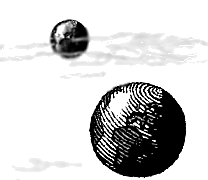
However, there was one particular difference. On Twin Earth,
the transparent liquid which made up the seas, lakes and rivers, which the
animals drank, and which fell as rain - the substance, in fact, which the
locals called ‘water’ – was not H2O, but XYZ. In most respects, and
without resort to more sophisticated chemistry, it was impossible to spot
any difference between the qualities and behaviour of XYZ and those of
H2O. | |||
|
| |||
 The strange result is that
when Robinson, on Earth, thinks about the contents of his glass, he is
thinking about H2O. But when Twin-Earth Robinson thinks an exactly similar
thought, with exactly similar brain states, he is thinking about XYZ. The
difference in what they are thinking about arises entirely from
differences in the external world, not from any difference in the two
brains. In the words of Putnam’s famous slogan ‘meaning isn’t in the
head’. The strange result is that
when Robinson, on Earth, thinks about the contents of his glass, he is
thinking about H2O. But when Twin-Earth Robinson thinks an exactly similar
thought, with exactly similar brain states, he is thinking about XYZ. The
difference in what they are thinking about arises entirely from
differences in the external world, not from any difference in the two
brains. In the words of Putnam’s famous slogan ‘meaning isn’t in the
head’. | |||
|
| |||
| In one way, this doesn’t
seem so surprising: it seems almost common sense that meaning is affected
by context. On the other hand, it seems a natural assumption that what you
think about is pretty much under your own control, something you arrange
for yourself within your own skull irrespective of the outside world. The
Twin Earth argument undercuts the idea that meaning can arise from mental
images or representations alone, which raises a difficulty for anyone
wanting to endow a computer with consciousness, and anyone applying a
functionalist interpretation to human consciousness. Computational
representations in one’s head cannot, it seems, be the same thing as
psychological propositions in one’s mind, at least not without some
further ingredient. | |||
|
| |||
|
OK
then. Now consider Twin Earth. Let’s suppose, instead of the water case,
we think about horses. On Twin Earth, let’s say, they have schmorses
instead; animals which resemble horses closely apart from genetics and
some internal details. If
some helpful philosophical aliens transport Robinson from Earth to
Twin Earth, and he sees a schmorse, what does he mean when he says
‘there’s a horse’? Does he still mean ‘horse’, or does he now really mean
‘schmorse’? Isn’t
this the same as the coin machine? Horse, schmorse, what’s the
difference? | |||
|
| |||
| But the two cases aren’t
the same. It’s OK to decide arbitrarily in the case of the coin machine,
because the coin machine doesn’t mean to identify any particular coin. It
does whatever we intend it to do. But my thoughts don’t depend on how you
interpret my behaviour. The machine only has derived intentionality – any
meanings come from the designer or user. But people have real, original
intentionality. When I mean something, I mean it all by myself,
irrespective of how other people may construe my meaning. | |||
|
| |||
 Ah, but that’s just where
you’re wrong, and that’s what Dennett explicitly denies. On your argument,
meanings must remain forever a magic mystery: if you want a rational
explanation, you have to accept that original, intrinsic meaningfulness is
absurd. How can anything, even a brain, mean anything
intrinsically? Ah, but that’s just where
you’re wrong, and that’s what Dennett explicitly denies. On your argument,
meanings must remain forever a magic mystery: if you want a rational
explanation, you have to accept that original, intrinsic meaningfulness is
absurd. How can anything, even a brain, mean anything
intrinsically? | |||
|
| |||
| I might ask, if all
intentionality is derived, where does it ultimately come from? Dennett
seems to think we can generate it from nothing by, as it were, taking in
each other’s washing. But if there’s one thing that’s clear to me, it is
that the meaning of my thoughts doesn’t in itself depend on other people’s
interpretations. I’ll agree that Dennett is right about one thing though –
this is one of the key issues, where people’s intuitions divide sharply –
almost as if they were on different planets… | |||
|
| |||
|
|
|
|
|
|