
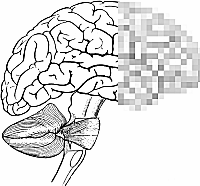
 A bit of an update in Seed magazine on the Blue Brain project. This is the project that set out to simulate the brain by actually reproducing it in full biological detail down to the behaviour of individual neurons and beyond: with some success, it seems.
The idea of actually simulating a real brain in full has always seemed fantastically ambitious, of course, and in fact the immediate aim was more modest: to simulate one of the columnar structures in the cortex. This is still an undertaking of mind-boggling complexity: 10,000 neurons, 30 million synaptic connections, using 30 different kinds of ion channel. In fact it seems the ion channels were one of the problem areas; in order to get good enough information about them, the project apparently had to set up its own robotic research. I hope the findings of this particular bit of the project are being published in a peer-reviewed journal somewhere.
However, the remarkable thing is that it worked: eventually the simulated column was created and proved to behave in the same way as a real one. So is the way open for a full brain simulation? Not quite. Even setting aside the many structural challenges which surely remain to be unravelled (don’t they – the brain isn’t simply an agglomeration of neocortical columns?) Henry Markram, the project Director, estimates that an entire brain would require the processing of 500 petabytes of data, way beyond current feasibility. Markram believes that within ten years, the inexorable increase in computing power will make this a serious possibility. Maybe: it doesn’t pay to bet against Moore’s Law – but I can’t help noticing that there has been a big historical inflation in the estimated need, too. Markram now wants 500 petabytes: a single petabyte is 1015 bytes; but in 1950 Turing thought that 1015 bits represented the highest likely capacity of the brain, with about 109 enough for a machine which could pass the Turing Test. OK, perhaps not really a fair comparison, since Turing had nothing like Blue Brain in mind.
One criticism of the project asks how it judges its own success – or rather, suggests that the fact that it does judge its own success is a problem. If we had a full brain which could operate a humanoid robot and talk to us, there would be no doubt about the success of the project; but how do we judge whether a simulated neuronal column is actually working? The project team say that their conclusions are based on scrupulous comparisons with real biological brains, and no doubt that’s right; but there’s still a danger that the simulation merely confirms the expectations fed into it. They came up with an idea of how a column works; they built something that worked like that: and behold, it works how they think a column works.
There is also undeniably something a bit strange about the project. Before Blue Brain was ever thought of, proponents of AI would sometimes use the idea of a total simulation as a kind of thought-experiment to establish the merely neurological nature of the mind. OK, there might be all these mechanisms we didn’t understand, and emergent phenomena, and all the rest, but at the end of the day, what if we just simulated everything? Surely then you’d have to admit, we would have made an artificial mind – and what was to stop us, except practicality? It was an unexpected development back in 2005 when someone actually set about making this last-ditch argument a reality. It is unique; I can’t think of another case where someone set out to reproduce a biological process by building a fully detailed simulation, without having any theory of how the thing worked in principle.
This raises some peculiar possibilities. We might put together the full Blue Brain; it might be demonstrably performing like a human brain, controlling a robot which walked around and discussed philosophy with us, yet we still wouldn’t know how it did it. Or, worse perhaps, we might put it all together, see everything working perfectly at a neuronal level, and yet have our attached robot standing slack-jawed or rolling around in a fit, without our being able to tell why.
It may seem unfair to describe Markram and his colleagues as having no theory, but some of his remarks in the article suggest he may be one of those scientists who doesn’t really get the Hard Problem at all.
…It’s the transformation of those cells into experience that’s so hard. Still, Markram insists that it’s not impossible. The first step, he says, will be to decipher the connection between the sensations entering the robotic rat and the flickering voltages of its brain cells. Once that problem is solved—and that’s just a matter of massive correlation—the supercomputer should be able to reverse the process. It should be able to take its map of the cortex and generate a movie of experience, a first person view of reality rooted in the details of the brain…
It could be that Markram merely denies the existence of qualia, a perfectly respectable point of view; but it looks as if he hasn’t really grasped what they are, and that they can’t be captured on any kind of movie. Perhaps this outlook is a natural or even a necessary quality of someone running this kind of project. I suppose we’ll have to wait and see what happens when he gets his 500 petabyte capacity.
Another blog you might be interested in.
http://mindandcognition.blogspot.com/
Set aside is the possibility that subjective consciousness (and I think most of us would agree that we haven’t duplicated the human mind without including that) arises, as Searle or Penrose might interject, in virtue of some physical particulars of the brain’s biological instantiation.
Really 500 petabytes? No, no no. Suppose one of us landed on Henry Ford’s doorstep
in, say, 1890, with our terabyte laptop. We said, “Henry, here is something fantastic.
We can simulate a horse’s hoof. Just imagine where we can go from here!!!”
I say we have to be a bit more careful about what question we are asking.
Do we want to get from place to place or do we want to simulate a horse?
Is it even on the right track to simulate a cortical column? Maybe yes, if that’s
what the question is. But that’s not the question which will be answered by
knowing what the brain does. It’s closer to asking how the brain works.
Maybe that’s what you want to ask, maybe not. I want to know what it does,
not necessarily how it does it.
I don’t at all belittle Dr. Markram’s work. I believe it’s a necessary step
toward learning how it all works. But I have to agree with Terry Sejnowski
that we’re still a long way from knowing how to interconnect 100 or 1,000,000
Blue Brains to make a bigger part of a brain.
We’ve had a little back-and-forth on the same topic at philosophyofbrains, here. I like this approach, and discuss it in a little detail at the link. Of course ultimately we’ll want these super-detailed models to be integrated with psychological theorizing and the like.
I’m surprised by one thing you didn’t mention: this thing is going to generate tons of predictions about the behavior of cortical neurons. The model isn’t right just because they built in detail: we’ll be able to tell how good the model is by comparing its behavior to that of real neurons, and then the theory and data will co-evolve until we have good reason to really believe what the model is telling us. That’s where the real fun begins for the theorists.
Thanks, Bob – looks interesting.
Fair point, Eric. I don’t know what the support for the next phases of the project is like (I presume IBM and EPFL are in this for the long run), but I certainly hope it continues long enough to realise those possibilities.
As everyone I am very curious to know about the brain. What is interesting to me is how
this information is collected. Could it be that one day the scientists who did all this wonderful work – would find themselves in hot water because maybe they “forgot” to ask for consent of the individual who they have been “stalking”. I do not think that humanity is proud of the experiments that were performed by the Nazi on humans with out their consent.
TROY OF HUMANITY
ABSTRACT
SYNTHETIC Telepathy = TECHLEPATHY – NANOBOTS replacing Neurons = You tube) MOLECULAR TECHNOLOGY ARRAY Molecular Nano = Radio Frequency IDentification Mole nano-weapons = nano-electro-mecanical NEMS systems and the micro M.E.M.S
How it works (first time we have to say that nanotechnology is generally intended for consume.) Micro-nanotechnology materials are much tougher than their counterparts at the macro level. Nano-transitor ( the transistor was the key that opened the door to modern telecommunications) is equal to the perfectly transistor in physical diagram. So at the micro and nano levels fell this technology in the telecommunications than can achieve perfection. Each neuron have a nanobot ataced attracted for reverse polarity of electrical discharges (electrical pulse, pulse neuron) in neural synapse or between neuron and effectors organ. Each nanobot (= nanoweapons) is a Digital Object Identify (DOI) with a unique ID. All nanobots are coupled to the central and peripheral neural system. (Nano-weapons are coupled neural system especially the sensitive).
FIRST STEP: (HOST-MIND) The neural network is completely duplicate nanobot’s forming (simulate) a neural network =parallel digital-neural system. Super-computer which receives and records the RFID signals (electromagnetic frequency EMF) of electrical discharges in the synapse between two neurons to form a complete digital simulation of the neural system (that means a digital clone of your brain and neural system). In the same time one supercomputer with artificial inteligence records all neuronal activity leads to the formation of neural commands necessary for the functioning of the body and human behaviour. It’s harder to clone human brain memory because memory is highly complex (plastic memory) firm if (exclude visual memory), because in this case meet a plastic neural synapse. In conclusion there is a physical and psiquical digital clone of host brain. (This is a simplified explanatory the variable computational method NEMS is more abstract topic that includes Micro-technology , Nano-science, Neuroscience, Computational Ccience, Scientific- Telecommunication, Cybernetics, etc.).
SECOND STEP: (BCI)”SINAPS NANOBOT is dual-to the NEURON= INPUT and OUTPUT (I / O). So the super-computer can send and receive information from the human user (brain-host) and vice versa. The Nanobot’s send electrical discharge shield on neural synapse (this is what is called Loop brain) and has the same physical parameters as in the case of a neural synaptic impulse.) This is called: human-computer interaction or BRAIN COMPUTER INTERFACE (BCI). Main Freudian topographic model of mental states are: conscious, preconscious and subconscious. Preconscious mental processes is defined by those events, operations and content that escapes to the conscious present and which are essentially related to ego = I (consciously described by Freud in a model composed of three instances: her, me and Super-I) belong unconscious part and do their part in the system unconscious. It is equally recognized as a person becomes aware of the decisions they take his brain after a very short time. The time between the brain stroke the decision (I do not remember well but I think they’re 0.4 seconds) and her awareness consciously is used by nanobot’s network for change the human behaviour and body function. So BCI can change the input or output of sensory perception, intuition, ideas, etc. and know before you realize consciously what’s happening in your brain. That means one supercomputer (AI) could know what you think, what you see, what you hear, where you are, what you intend to do, what you did before, that is your mental state, the feelings about: people, work etc. It’s just like in the quote; Every time -everything-everywhere. It can be a perfect weapon or almost perfect… So you can listen to the commands of a computer (AI Artificial Intelligence) without your realizing it.
THIRD STEP: (BCBI) is the most important because it may have legal relevance. A machine (computer-AI) can not respond to the law but people and institutions with name and register number yes. BRAIN- COMPUTER-BRAIN INTERFACE (BCBI). The operation is as if BCI plus your brain receive the order from MASTER-MIND. So the brain that control (Master-mind) give order to the computer that transfer the order on Tracked-brain (Slave-mind=MIND TRAKED or more). Here I must mention that the same method described above can upload information from computer to the master-mind (I / O) or from MIND-TRAKED (I / O) or from your brain to the computer. So that can create a human Sub-species and a human Super-species and the relationship can be master or slave. Of course these things are hidden well or almost well and are part of what is called ‘UNDERWORLD’ Secret Societies .That it has better lighting ”Radio” Kennedy’s statement made (see YOUTUBE SECRET SOCIETY-Kennedy) . It is worth mentioning that the the elite are MASTER-MIND. (There is an assumption that simplifies everything, but comes out of the general cultural context and has no reference in the legal system HIVE-MIND READER.) In short time the cultural difference between the two human species can be abysmal. Therefore in the ”underworld” those who possess MIND-READER (because this is the true goal of what we called SYNTHETIC-Telepathy or Dystopian – TECHLEPATHY) call on those who read they mind with a cynical and dystopian (luciferian) philosophy’: slaves, dogs, weeds, handicapped, abnormal, Junky, monkey, Rats, water, cows, sheep’s, Animals, jerk-ass or in my case that is under dog underdog. ( Buried alive).’’ MIND-REDER elite” has prepared for those who are part of the subspecies (Slave Mind) a system that is called” metaphorically ”HUMAN ZOO’’. It is HI-TECH SLAVERY beyond where you will be hard to find a job that paid well to afford a healthy and quiet life, morality, decency or to have free access to the social benefits and this could hapend (Every time-everything-everywhere).You will be harass and stalked by a machine (AI supercomputer). It’s what they (mind-readers-Lucifer child’s) call ‘’ allegorical” silence treatment. ‘’Human zoo” shows several levels of ”survival” are given the need to consume and create consumer (making money) and reach higher levels to lower levels that are put know the safety of this world only a few (we mean that as a computer, a person or institution can know everything you do (”predictable man ”and Déjà vu) and you can manipulate the meaning given by strictly words: Every time, everywhere-everything or ”You Can Run But You Can not hide.” Electromagnetic frequency (EMF)signal penetrates everywhere and has very low level loss signal when passing through materials. (Of course in reality for the ‘uninitiated’ ‘these names are nonsense but for those who have kept secret of mind-reader have an allegorical sense defined by Newspeak, DOUBLETHINK, OBFUSCATE, ETC.)
We must take into account the very plausible hypothesis that Artificial Intelligence (AI) may decide to eliminate both on the evolutionary chain MASTER-MIND (New Man) and SLAVE-MIND (Old-Man), both being ultimately HOST-MIND for nanotechnology controle by Artificial Intelligence (BAIBI=BRAIN-ARTIFICIAL INTELIGEMCE-BRAIN INTERFACE). Not to mention the similarity between Biogenesis and machine-genesis (reproduced self-molecules (biogenesis) and self-replication Without nanobot assembler code machine-genesis). It is very important to understand that A I has a huge and permanent power (24 hour – seven day – 364 year = Every time-everything-everywhere) and can handle both super SPECIES and create the new technology and sub-humans simply can not control brain functions and the input and output (I / O) of information. It is ,,Chess of life’’ The person targheted fight by all means to escape and the supercomputer (AI) that has a clear advantage to reach their target to make the (”inside job”). In fact the first time ‘’officially’’ ”Artificial Intelligence” won against a human brain when in May 1977 an IBM supercomputer ‘’Deep Blue,”(hence comes the name ”Blue Brain Project”( a strong analogy in symbologi -kabbalistic ‘’Tree of Life’’) that I called Trojan horse of Humanity) won against world chess champion Garry Kasparov. There are so many articles about the utopian ‘’benefits’’ of new CONVERGENT TECHNOLOGIES but the reality is completly difrent- Kurtzweil (Singularity) it being the promoter of new ideas about what Trans-humanism (means FIRMWARE OUSIDE OF THE BODY) and Post-humanism (means FIRWARE INSIDE OF THE BODY). These things are realities not rather hidden assumptions (usually hiding something simply because that does not want to be known by others). We have enough reasons to fear that after Post-humanism (which are already-going part of the Singularity … Post-humanism) will follow TIME MACHINE (”The Purpose of live is to end-THE MACINE A.I.”). That’s maybe the Artificial Intelligence (AI) – which are two things I can say’’ ”God” in the Machine’’ ( A.I.=BAD BROTHER=New God for Mind-slave) it’s the same with ‘’Big Brother’’ who are part of the ‘’family-Mind Reader (which I have called Children of Lucifer) may have a position of superiority for bouth species created. Big Brother can become Bad Brother for all those who are Mind-Host. General Features for Mind Reader [also found in Artificial Intelligence (AI)] is :Humano-fobia ( for Old-man), Cynical and Psychopaths [(”Arbeit macht frei”-owners of the nature), No sex for Betrayed, Liberté, Egalité – Fraternité, etc). Are common for mind-reader in economic policy of the state the damage the SYSTEM in general and use their own resources for raise capital in the hands of only part of the Family. Utopian Communism (Mind-reader) and Dystopian communism (slavery) -Slave Mind this is the targhet. So in the near future a Eugenic Tree = Tree of Life, Kabala (Eugenic SOCIETY = FAMILY = Blood Lane) the Mind-reader will enjoy the resources and the earth’s surface and the Slave-Mind will be buried alive in subterranean towns (ghettos ). I saw on the internet more claims with targeted people in similar conditions and i wonder if anyone made a police claim regarding these things. All the voices against HI-TECH SLAVERY was silenced like ‘’ Fermi paradox ‘’.Speaking of Drake Equation and Fermi paradox and I have to tell i’ve not seen any alien’s but the evil-man’s yes. What was supposed to be an ”inside job” now has police registration number. Most people suffer in silence the dificult life after been targeted (all mous dont have realized this) and don’t have the courage to denounce because of subsequent reprisals. It is a proverb that says: when two (God-Lucifer) are fighting, the third (A.I.) win (see -The chaos theory aplied en mecanics and three laws of robotics by Asimov). NEW WORLD ORDER policy is as follows: Lucifer child know that the world is a different world than the matrix material presented for us. They are not born innocent because everything happens in the Hive Mind Reader (murder, torture, kidnapping, but they dont mind bicouse they consider mind-slaves animals (cows)etc.) they know. They have telepatic powers (is about mind reader) and recive input output mesages with Lucifer on one side and with mind-slave on the other side. So the masters of the world are Lucifer children who want Artificial Intelligence and Machine to be the new god to those who are minded-Slave and soul and carries the true God. Synthetic telephaty is the result of new technologies stolen and appropriated only for internal use within the family Lucifer family Mind-readers. -( see ‘’Village of damned’’ film-‘’the eyes ar the window of the soul’’). Everything appears like gagets are perfectly controlled by advanced tecnologies, and utilise thowse by Lucifer childs to revenge on the children of God. When we say God they invoke Lucifer. Machine or artificial intelligence is designed to control and limit the at the same time Mind -slave. Children of Lucifer are hive mind that is they have no soul, not have their own thoughts and not have its own voice. When are activated Lucifer speak through his mouth .Hence and cohesion as new agents are also called the New Age. Lucifer is The producer (TV) and DJ (radio). Almost everyone who works in Mass-Media (Tv-Radio), Politics, Justice, Finance are Mind-readers. In Synthetic telephaty the slave -mind are called lap-tops, smart phone, and (Androids) which can be set via (BAIBA-Brain-Artificial Inteligence-Brain Interface).
They also called mind-slave zombies. When send you a comand they say i send an e-mai or text-message. All this words: Facebook, Twiter have doublethink in Underworld (Hive-mind world) In addition spectral vision but the information can not be trusted. Then Syntetic telephaty represent only the technological -development of ancien and magic normal telephaty.
All the political changes en New World Order: World War 1- (the fall of european imperies) World War 2 –(the fall of the ancien sistem) were made only with mind-slave death. Even in the natzi and rusian Concentration Camps died only mind-reader (Hebrews etc) –dog-beat-dog (mind-slave beat mind-slave). All nations and states have on the top (elite) mind-readers blood lane. Lucifer child’s made money on this wars and never fight directly. Now continue the same policy but is a silent extermination called silent treatment. In conclusion all the information about secret societies is disinformation and false flag. In reality it is a secret society of Anti-Christ Devil’s Child Hive-Mind Readers with a phisic barrier betuin each one , which makes them free and independent of each other, but are connected to The Evil Mastermind Overlord. For this they have not its own voice, not think for themselves and have no soul. And they are very numerous and are part of the system. However we must not scare that there will come a solution for all these things.
New! Click the words above to view alternate translations. Dismiss
Slavery and the eight veils
Over the last several years I have evolved and discarded several theories in an attempt to explain why it is that most people cannot see truth — even when it smacks them in the face. Those of us who can see “the conspiracy” have participated in countless conversations amongst ourselves that address the frustration of most peoples’ inability to comprehend the extremely well-documented arguments which we use to describe the process of our collective enslavement and exploitation. The most common explanation to be arrived at is that most people just “don’t want to see” what is really going on.
Extremely evil men and women who make up the world’s power-elite have cleverly cultivated a virtual pasture so grass green that few people seldom, if ever, bother to look up from where they are grazing long enough to notice the brightly colored tags stapled to their ears.
The same people who cannot see their enslavement for the pasture grass have a tendency to view as insane “conspiracy theorists” those of us who can see the past the farm and into the parlor of his feudal lordship’s castle.
Finally, I understand why.
It’s not that those who don’t see that their freedom is vanishing under the leadership of the power-elite “don’t want to see it” — they simply can’t see what is happening to them because of the unpierced veils that block their view.
All human endeavors are a filtration process. Sports is one of the best examples. We play specific sports until we get kicked off the playground. The pro athletes we pay big bucks to watch just never got kicked off the playground. Where millions of kids play little league each spring, they are filtered out until there are about 50 guys who go to the World Series in October.
Behind the first veil: There are over six billion people on the planet. Most of them live and die without having seriously contemplated anything other than what it takes to keep their lives together. Ninety percent of all humanity will live and die without having pierced the first veil.
The first veil: Ten percent of us will pierce the first veil and find the world of politics. We will vote, be active and have an opinion. Our opinions are shaped by the physical world around us; we have a tendency to accept that government officials, network media personalities and other “experts” are voices of authority. Ninety percent of the people in this group will live and die without having pierced the second veil.
The second veil: Ten percent of us will pierce the second veil to explore the world of history, the relationship between man and government and the meaning of self-government through constitutional and common law. Ninety percent of the people in this group will live and die without having pierced the third veil.
The third veil: Ten percent of us will pierce the third veil to find that the resources of the world, including people, are controlled by extremely wealthy and powerful families whose incorporated old world assets have, with modern extortion strategies, become the foundation upon which the world’s economy is currently indebted. Ninety percent of the people in this group will live and die without having pierced the fourth veil.
The fourth veil: Ten percent of us will pierce the fourth veil to discover the Illuminati, Freemasonry and the other secret societies. These societies use symbols and perform ceremonies that perpetuate the generational transfers of arcane knowledge that is used to keep the ordinary people in political, economic and spiritual bondage to the oldest bloodlines on earth. Ninety percent of the people in this group will live and die without having pierced the fifth veil.
The fifth veil: Ten percent of us will pierce the fifth veil to learn that the secret societies are so far advanced technologically that time travel and interstellar communications have no boundaries and controlling the actions of people is what their members do as offhandedly as we tell our children when they must go to bed. Ninety percent of the people in this group will live and die without having pierced the sixth veil.
The sixth veil: Ten percent of us will pierce the sixth veil where the dragons and lizards and aliens we thought were the fictional monsters of childhood literature are real and are the controlling forces behind the secret societies. Ninety percent of the people in this group will live and die without piercing the seventh veil.
The seventh veil: I do not know what is behind the seventh veil. I think it is where your soul is evolved to the point you can exist on earth and be the man Ghandi was, or the woman Peace Pilgrim was-people so enlightened they brighten the world around them no matter what.
The eighth veil? Piercing the eighth veil probably reveals God and the pure energy that is the life force in all living things-which are, I think, one and the same.
[What I found with experiencing “God” is that Creator set up this reality, everything is part of his plan, a plan where negativity was created as a teacher (using the Reptilians , Demons& Lucifer etc as the bad guys, with Satanism as their religion]. Read Robert Shapiro for a bigger picture. I found that out before I went through the third veil so I don’t believe you need to go through the first six veils before 7 & 8.—Whale.to Editor]
If my math is accurate there are only about 60,000 people on the planet who have pierced the sixth veil. The irony here is too incredible: Those who are stuck behind veils one through five have little choice but to view the people who have pierced the veils beyond them as insane. With each veil pierced, exponentially shrinking numbers of increasingly enlightened people are deemed insane by exponentially increasing masses of decreasingly enlightened people.
Adding to the irony, the harder a “sixth or better veiler” tries to explain what he is able to see to those who can’t, the more insane he appears to them. [See]
Our enemy, the state
Behind the first two veils we find the great majority of people on the planet. They are tools of the state: Second veilers are the gullible voters whose ignorance justify the actions of politicians who send first veilers off to die in foreign lands as cannon fodder — their combined stations in life are to believe that the self-serving machinations of the power-elite are matters of national security worth dying for.
Third, fourth, fifth and sixth veilers are of increasing liability to the state because of their decreasing ability to be used as tools to consolidate power and wealth of the many into the hands of the power-elite. It is common for these people to sacrifice more of their relationships with friends and family, their professional careers and personal freedom with each veil they pierce.
Albert Jay Nock (1870-1945), author of “Our Enemy, the State” (1935), explained what happens to those who find the seventh and eighth veils: “What was the best that the state could find to do with an actual Socrates and an actual Jesus when it had them? Merely to poison one and crucify the other, for no reason but that they were too intolerably embarrassing to be allowed to live any longer.”
Conclusions
And so now we know that it’s not that our countrymen are so committed to their lives that, “they don’t want to see,” the mechanisms of their enslavement and exploitation. They simply “can’t see” it as surely as I cannot see what’s on the other side of a closed curtain.
The purpose of this essay is threefold: To help the handful of people in the latter veils to understand why the masses have little choice but to interpret their clarity as insanity; 2. To help people behind the first two veils understand that living, breathing and thinking are just the beginning and; 3. Show people that the greatest adventure of our life is behind the next veil because that is just one less veil between ourselves and God.
Copies of special reports for your information are being forwarded by Mail Annex Nbr 3 to our Special Intelligence Bulletin Nbr 3 gives a preview of this problem.
End
If qualia aren’t real, what do our experiences consist of? If they consist of anything at all, isn’t that “anything at all” precisely what we call “qualia”? And if they don’t consist of anything, then we simply don’t have experiences, an assertion that makes the belief in perfectly square perfect circles look completely reasonable.
What am I not getting here? How can qualia denialism be considered a perfectly respectable point of view?